The Road to Pocsi

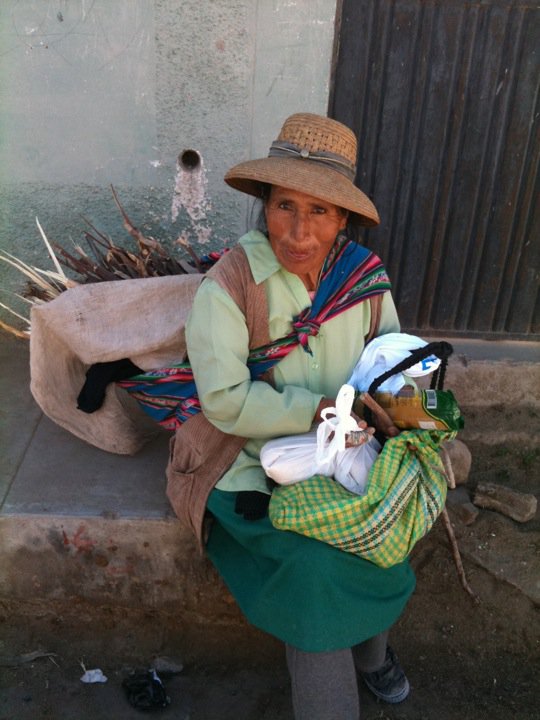
I had the opportunity not long ago to travel with some friends to Peru on a medical mission. We traveled from Lima to Arequipa, and then on to Pocsi. It was one of the most memorable trips for me, not only because of the places we visited, but because of the people we met. I learned I don’t know enough Spanish to communicate in a taxi, when we were separated from the group. I did manage to point enough to get back to the mission house. Peru is a beautiful place dotted with volcanos and green agricultural fields. The people are kind and welcoming. We decided to travel over the mountains to Pocsi one day to visit a women’s detention center and take them necessary items. We also brought a doctor with us to examine the sick. We set up a dental mission to see patients in the afternoon. Walking through town in the morning, we prayed with locals and offered them food and clothing. I had a translator who helped me to communicate with those we came across along the way. The picture above is of a woman who was carrying a backpack of cuttings down the road, and she let us pray with her. We gave her a bundle of food, and she let me take her picture. I gave her some Sols in return as a kindness.

In order to reach Pocsi, we had to travel along a narrow road that made its dusty way around the mountains. When a car would come from the opposite direction, we had to pull as close as we could to the side, in order to allow the car to get by. It often looked as through we would slide down the side of the mountain, as the wheels hung over the edge. On the way up the mountain, we saw a man sitting very close to the side of the road. He had a blanket over his lower body because he was paralyzed. His family would bring him out every morning before leaving for the day. He had been doing this for years. He would sit there in the sun all day and talk to people as they passed by. People would often give him money. We stopped and prayed with him. It was a feeling I will never forget. He was just happy to interact with people. I heard recently that he had passed away. I prayed a lot on that dangerous road, but when we finally reached town it was worth it. The women’s detention center housed many young females who had turned to prostitution or theft as a means of support. They lacked the necessary hygiene products, so we brought some to give out, as well as food and clothing. We also shared scripture with the women and just talked with them about their lives. Most wanted a different life but didn’t know how to get away from it. Many children came to the dental mission we set up in the afternoons and saw the dentist we brought. We entertained the families in the waiting area and shared scripture and food with them. Several families also visited the doctor who came along, and that group shared scripture and food with them as well. Only one man in town was not happy about our presence. He was the town drunk and referred to us as gringos. It means stranger but in a very negative way. It seems there was usually one local who didn’t like outsiders in every town, but we didn’t mind.

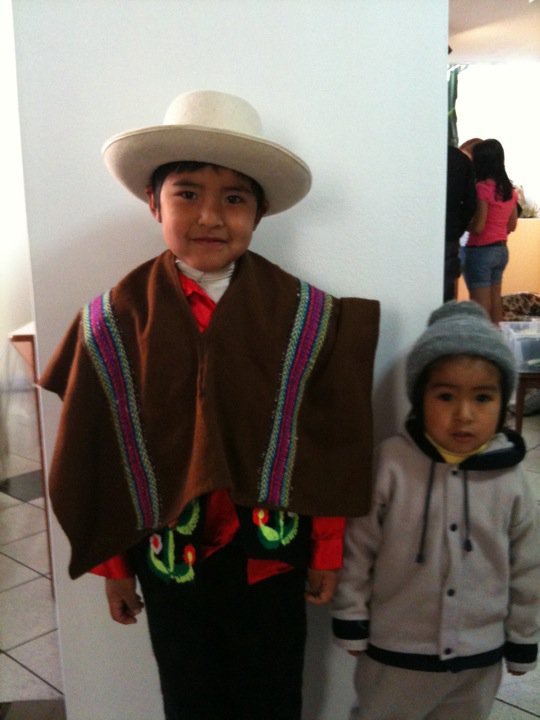
One evening after we returned to Arequipa, we showed a movie and invited the townspeople to come. Many women came with their children. Some of the women spoke a language that was very different from the Spanish we were accustomed to. They wore colorful, traditional outfits and looked more tribal than the local citizens. One of my missionary friends told me that when the Spaniards conquered Peru, they intermarried with the local tribes (Incas). Some tribespeople fled to the mountains, and they kept their language and traditions alive, including the colorful tapestry clothing. The brightly colored clothing is woven from Alpaca or llama wool, which is a large export of Peru. Llama wool is actually more rare than cashmere and very valuable. A sweater can fetch upwards of $250 U.S. dollars. These tribesmen/women are known today as the Quechua people. The Quechuan language is considered the original language of the Incas. There are over 45 Quechuan dialects.
We also had the opportunity to enjoy much of the local cuisine in Arequipa. It consists of fish and meat, soups, and vegetables. The potato, which was first cultivated in Peru before it spread to the rest of South America and eventually Europe in the 16th century, is represented in almost every meal. Local stores abound with every kind and color of potato imaginable. Over 4,000 varieties are grown in the Andes of Peru. It is the staple food of locals and has been used for everything from medicine to time calculation over the centuries. While in Peru, I enjoyed one of the best desserts I’ve ever had. It was a cake made from Cherimoya fruit. The fruit tastes like a cross between a pineapple and a banana, with a creamy pudding-like texture. I have never had anything like it since. Peru is truly a land to be discovered. The people are friendly and welcoming, and the food is unlike anywhere else. You don’t have to go to Machu Picchu see the best Peru has to offer. Visit the local towns and soak up the sights and sounds.
Posted in Uncategorized | Leave a comment

Unwanted Bedfellows – A Journey to Africa

One night during our encampment in Africa, we all sat around the campfire drinking bush tea and listening to stories from the missionary, Kerry, who was stationed in Zimbabwe. He and his wife had been there for their entire married life and raised two boys who were currently in college. Kerry had traveled all over Africa and met many people from different tribes. He regaled us with tales of train rides, Swahili tribesmen, and floods from the monsoons. I marveled at the stars in the Southern Hemisphere. I never thought much about how we only see certain stars from where we live. I had seen the same stars my whole life, but now the sky was filled with a new set. I could see the Southern Cross, Scorpius, and the phenomenal Milky Way. Pollution is a lot less in the Southern Hemisphere so some stars are more visible there as well. The Milky Way was the most beautiful thing I’d ever seen. It was like a swath of white pixie dust straight through the sky overhead – like a glimpse through the Hubble telescope into the heavens. I felt blessed just to be seeing it.
After we were so tired we couldn’t sit up anymore, we retired to our tents. We had about seven tents encircling the campfire, and the village huts surrounded us. The guides were on the truck parked off to the side. I am a light sleeper and being that I was in the middle of two women in a two person tent, sleep was challenging. At some point during the night, I awoke to the sound of footsteps around the tent. I listened to see if it was someone getting up to use the bathroom, but I soon heard zipping and unzipping of our luggage in the adjacent tent. We had put the luggage in another tent so one of us women wouldn’t have to sleep alone. I woke up my tent mates and asked them to listen. We decided to call out to Jeff, another guy in our group, who was in the next tent. When he answered, we told him we heard something. We heard the footsteps again, and then we all stepped out of our tents. As we were all discussing what we had heard, suddenly, shrill screams came from our translators’ tent. They were screaming for help. As everyone else roused, two men suddenly ran from the translators’ tent. It was dark and faces could not be seen. We stood there in shock. Who were the men, and what did they want? Guns in Zimbabwe are against the law, so I was never really all that afraid. If a person is reported to the government as even being suspected of having a gun, they are carried off to jail. These men couldn’t be armed with guns so should we be afraid? Everyone in the group was a little shook up and our African translators were terrified. They had awakened to find two men in their tent, standing over them.
The next morning, the chief/pastor told us it was the work of some drunk men who were looking for money. He said they were going to carry out their own system of justice in the village. The missionary, Kerry, said the men would be beaten for their behavior. For some reason, I felt sorry for them. I wondered who they were, and if we would talk to them on our way around the village and not even know it. How would they feel about us after they were beaten? It was out of my hands as was most everything else about the trip. I had to believe that God had a purpose for all the things that happened there.
– And we know that in all things God works for the good of those that love Him, who have been called according to His purpose – Romans 8:28 NIV


Posted in christianity, religion | Tagged , , , , | Leave a comment

The Night We Needed Stephen Spielberg

As we visited with the villagers one day, we noticed a crowd forming. When we would leave one home, the person we had just talked with would follow us to the next hut. After a while, we had a crowd of people following us. I asked the translators what was happening, and they said the people wanted to hear what we said again. I noticed that some people had chosen to post their tracts (small sheets of paper containing the book of John that we had given them) on trees. It was wonderful to know that they were truly interested in what we were saying. The translator said that they didn’t have paper or pencils, so the only form of communication they had was by mouth. They wanted to be able to tell the story of what we had shared with them again to someone else. Once, I needed to write something down during a visit, and I used a Papermate pen that I was carrying in my bag. Our translator commented on how much he liked it, so I gave it to him. A world without anything to write on or anything to write with – I could hardly imagine that! The village school didn’t even have those things. We brought several packs of crayons, paper, and pencils for the school.

Part of our group had been assigned to the school. I was supposed to assist in teaching various classes since I was a teacher, but the first group that visited there was not received well by the headmaster, so I never got the chance. A woman in our group was a nurse, so a decision had been made to have some health related classes for the girls who attended there. School cost a lot of money so mostly only boys were sent for classes. There seemed to be a pervasive school of thought that AIDS was passed down through families. One of the chief/ pastor’s daughters shared this with me. She told me how someone in her family had died of AIDS so she would probably get it too. I told her that someone couldn’t get it automatically, that it was passed by bodily fluids or through pregnancy from mother to child. Sadly, I learned years later she had passed away due to an explosion while using a generator. She had been burned over most of her body. It wasn’t AIDS that killed her. The classes at the school that our group were coordinating covered AIDS, using protection during sex, and of course, abstinence. There was also a class for mothers, to teach them about prenatal vitamins and caring for their children. The headmaster had allowed the classes, but one day he came in and told everyone to leave. Maybe, he was being pressured from local officials.

Every evening, we provided a church service outside for everyone we had spoken with during the day. It was dark, but we strung up a light bulb which ran on a generator. People would come from far and wide as word spread. They would just all appear in the darkness and crowd around. One night, we were going to show a movie about Christ’s life and ministry. We had permission to show the movie on the side of the school building. People around there weren’t familiar with television or even pictures. We would take Polaroids of the children and give the pictures to them. They loved looking at themselves. On the night of the movie, crowds of people came – groups of women with children on their backs and older children running around, men standing around in groups, and even the elderly who could make the journey. On our way to the school, before the sun went down, we had passed many walkers. As our truck would pass, people would hold up an index finger. This happened a lot as we would travel the roads. I was told that a long time before us, a traveling mission group had come through and taught them that sign which meant one God. They knew we were missionaries too, and that was how they were communicating with us. A woman would always come to the services and bring a tall drum. She would play it and the chief/pastor’s daughters would sing and lead the crowd in song. Sometimes, the woman would let her little boy (he was about four or five) play the drum she brought. He was amazing. He would play like an adult, and he had so much energy!

The night of the movie, we set up the projector and started the movie. It played for a short time but the bulb blew out. The crowd was very disappointed. The chief/pastor talked with our missionary leader, and then the chief spoke to the crowd. He tried to explain the situation, and when they realized the movie would not come back on, they all let out a sigh. At every service, one of us would share our personal testimony. This particular night was not my turn, so I watched the crowd. After the movie cut off, the chief introduced the one in our group who would share his testimony. There was a group of men who would shout out throughout his story. The crowd would laugh at what they were shouting. This went on for awhile, and I could tell the men were drunk. They were stirring up the crowd. More people began to shout and laugh, and the crowd began to surge. There were hundreds of villagers there. Throughout the evening, young children would approach me and say hello in English. They were taught English in school, but hello was all they could say so far. Sometimes, they would talk to me, and my translator would tell me that they wanted to touch my skin or my hair. They weren’t used to seeing white skin and blonde hair. I would let them touch my skin, and sometimes the younger ones would let me pick them up and hold them. Back in the village at the campsite, we would play soccer with them. Little girls would run around with sibling babies on their backs, and little boys would chase them. We gave them a ball to play with because they had been using trash that was tied together to make a ball. We would sing songs with them and dance. We had bonded with many of the children, and I loved being with them. This night, the children were so sweet, but I felt the atmosphere was changing. As the crowd continued to grow and the drunk men whipped them into an angry mob, I began to wonder about our safety. It was very dark, but I could see the concern in the movements of our guides. I made my way through the crowd, keeping to the edges. The guide who drove our truck was blocking the entrance to the truck with his body. He shouted for me and some other women in our group to board the truck immediately. The crowd pushed against us grabbing and yelling as he blocked us with his body. We boarded the truck, and others in our group soon followed. The crowd surrounded the truck, but as soon as everyone was on board, the driver cranked up and drove out leaving the crowd behind us. I know that if we hadn’t left when we did, things probably would’ve turned out differently.

Posted in Uncategorized | Tagged , , , , , , | Leave a comment

Mines and Missionaries of Africa

20130617-012554.jpg  Our drive into the mountains by over lander truck, kindly nicknamed the “Cocky Robin”, had taken us past small villages and citrus groves, women walking with babies on their backs and large vessels of water on their heads, and roadside stands selling American brand T-shirts that read Adidas and Nike. I found it strange how so many people wore American brands or shirts that said, “I love New York” or “LA Dodgers.” Our African translators even had American names – Jeffery and Stewart. Buses bursting at the seams, filled with passengers and animals passed us periodically, and I often wondered what it must be like to be one of the sea of humanity who had to travel in a such a cramped and stifling environment. Americans start complaining if their flight is delayed for even a few minutes. The roads in Zimbabwe, more often than not, were one lane dirt roads, and I would watch and wonder if we were going to die with the next approaching truck or bus. Somehow, by the grace of God, we would squeeze past each other, and I would be able to take a breath again. Our guides were “MK’s” or missionary kids, who all grew up in Zimbabwe. All three were young adults, that shared a zest for life and had so much knowledge about the area and the people.
When we arrived at our campsite, it was late in the day, and we had to rush to get the tents up. Once the sun went down, it was utter darkness. I didn’t realize until then, what true darkness was. When lying in the tent without the assistance of any light, a hand waved in front of the face was impossible to see. I guess I had always been around some type of light, and the realization of complete darkness scared me. I prayed for safety because I felt completely vulnerable. Our bathroom consisted of a long walk with a flashlight to a tiny, cement structure with a hole in the floor – not somewhere one would go without an escort, or as we called it, a lookout. When we set up the tents, all the villagers gathered and stared. They spoke in Shona, and I wondered what they were talking about. We were told to secure all money and valuables in the safe in the truck. They referred to it as the refrigerator. We women were paired up in tents, but we decided that we would rather sleep three to a tent than to leave one of us alone. We put all of our duffle bags in the other tent, and then we could change in there. We had dinner that was prepared over the fire by our guides. They slept in the truck and on top of it to protect it. Once night fell, we sat by the fire and talked with our translators about Africa and America. They were young, college-age brothers whose parents had died from AIDS. The chief/pastor of the village had a wife and two daughters who also acted as translators for us. The daughters didn’t arrive until the next morning. They attended college in the city, and they had to walk all night to get to the village. They walked in the complete darkness, without shoes, through the mountains at night -unbelievable to me but true none the less. I asked Jeffery if they worried that something would happen to the girls, but he said they did it all the time. He said children would often go missing because they were used in sacrificial ceremonies of witchcraft. At that point, I was not a believer of such practices, but I soon found out they were very real. He also told me how people in Harare and other places would be taken from their homes by the government for speaking out against officials. They were never seen again. He told me that we should never speak of the government to anyone because they had spies everywhere. I went to sleep that night wondering if spies were watching us from behind the trees. During the night, I heard a truck go through the camp. Trucks weren’t common among the villagers, really not at all. The chief was considered to be the wealthiest of the group, and he only had a bike that we gave him. The missionary who met us there had a Toyota pickup, but that was only because he was American. I wondered who our visitors were, and the next morning I was told it was a visit from local officials to see what we were up to. Many nights we would hear explosions off in the distance. There were mine fields close by from a prior war with Mozambique. Cows wandered throughout the village and would often wander into the mine fields during the night. Cows don’t read so they never had a chance. I saw many people, including children, with missing legs due to coming in contact with unseen mines.
Each morning, we would get up around sunrise, eat breakfast, and meet for prayer and instructions. I was paired with Jeffery, an older gentleman from my church named Gene, and the chief/pastor’s wife. Everyone called her “Amai” which means mother in Shona. After our morning meeting, we would walk to an area of the village to which we were assigned. We would knock on the gate of each hut and wait for a response. The person at home would come out and converse with our translator and then ask us into their courtyard, so to speak. We would sit on a tree log, stump, or strewn fabric and the homeowner would offer us water. It was rude not to accept the offer, but I was told all the water came from the bore hole, otherwise known as a well. We had been drinking the same water as it was brought to us in large barrels upon our arrival. The bore hole was dug by World Vision, and due to its depth, it was presumed safe. The water from the bore hole actually tasted much better than the water we had been drinking from the tank on the truck. The water tank on the truck was right next to the diesel tank, so it pretty much tasted like diesel fuel. After exchanging small talk, we would explain that we were there to share some information with them about Jesus Christ. We had printed “tracts”or small sheets with excerpts from the book of John. The villagers were very kind to us, and they would ask us questions as we explained Jesus’s life and ministry. We would end with the ABC’s – Accept Christ into your heart, believe that he died for your sins, and make a public confession/ profession of your belief in Him. If they didn’t decide at that that time to accept Christ, we would ask to pray for them or their family. They would often just want us to pray with them, which we were happy to do. Sometimes, they would ask us what we did to sin (because we told them we were all sinners and needed Christ). I was a little taken off guard by this, but I would try to be as honest as possible without delving too deep. Two women told us they couldn’t accept Christ because they made alcohol which they sold for money to support the family. They used berries from a local tree to do this. In the Shona culture, drinking, smoking, and cursing were looked down upon. The village had their own system of justice for immoral behavior. We offered to pray with them.
One day, the missionary dropped us off a far distance from our campsite. We were to walk around another area of the village and talk as we usually did. It was very hot, even though it wasn’t noon yet. In the mornings, the women worked in the fields while caring for the children. The men went off, and mostly only the elderly were at home. Their family unit was strong and all members were to support each other financially. If a death occurred, the dependent went to live with other family members. Elderly family members were taken care of by their adult children. Many of the elderly had cataracts due to the bright sun and the lack of sunglasses. Sometimes medical missions would come and provided eye exams and used glasses. Lines were long and many were turned away due to lack of time. While walking back to meet our missionary for pick up, we saw a man sitting in the middle of a mine field. He was old and missing a leg. We stopped and asked the man if he needed help. We couldn’t go in, but maybe he could retrace his steps to find a safe way out. He told us he had purposely gone into the field because he was cursed. He said that he wanted to die because there was nothing he could do about the curse. He looked very disoriented, and we couldn’t convince him to come out. We told him what we were talking about with the villagers and asked him if he was interested in becoming a Christian. He wasn’t interested in accepting Christ, but he did want us to pray for him. We prayed with him, and we finally coaxed him out of the mine field.

Posted in Uncategorized | Tagged , , , , | Leave a comment

Everything I Needed to Know, I Learned in Africa

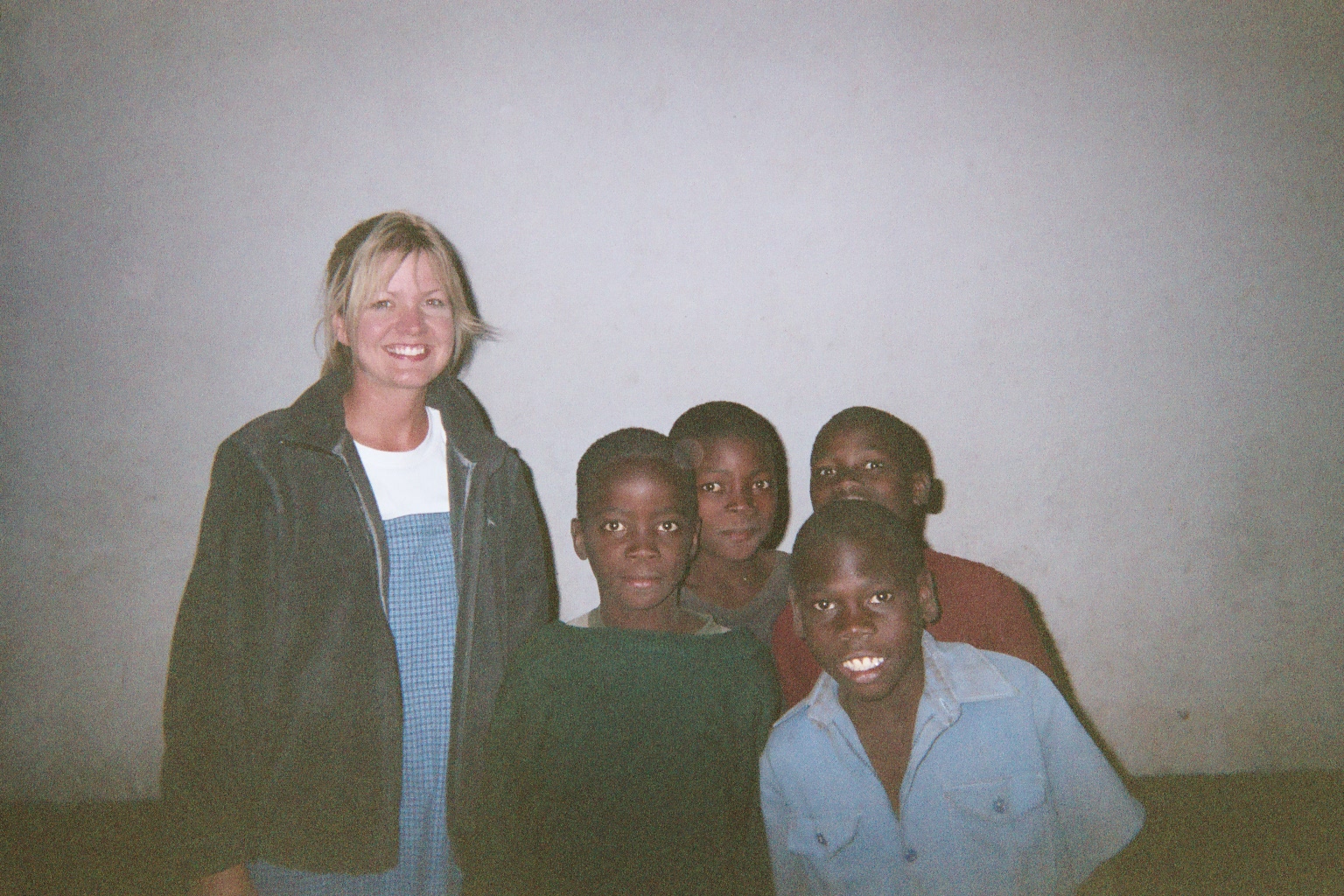
20130615-134812.jpg  In 2005, I decided to go to Africa. My friends and family thought I had lost my mind, but I didn’t care. I felt that God had a plan for me, one that I didn’t exactly understand, but it was something I had to do. I had never been out of the U.S., and I had never talked to strangers about my faith. I often questioned myself. What could a white, blonde-haired, blue eyed, thirty-four year old American woman do to change the world? I was told that the people we would be living among for two weeks lived in thatch-roofed huts and were considered some of the last unreached people groups left in the world. The only medical care they received was from passing mission groups, and the well they drank from had been dug by World Vision. Before the well, many died of water born illnesses. Children’s life expectancies depended on immunizations brought by traveling mission groups as well.
On July 4th, when all my family was at our lake cabin celebrating, I was on a plane to the unknown. We were headed for Johannesburg, South Africa, and then our final destination, so I thought, was Harare, Zimbabwe, formerly Rhodesia. We landed In the Cape Verde Islands at night, where we refueled, restaffed, were searched again, and then we were off again in under an hour. From Harare, we would travel by over lander truck to a village up in the mountains. I had been told that Zimbabwe was a dangerous place, and that it was under the grip of a cruel and merciless dictator, Robert Mugabe. Even though he was “elected”, he uses his power to influence voters through violent means. Those who oppose him are not given food rations and their homes are bulldozed. We witnessed the devastation from the bulldozing. We were told not to wave with an open hand at anyone, or make a fist because this could be taken as an act of disrespect to Mugabe. His primary political opponents used hand gestures to signify defiance and strength of their own political party. We were also told that he had spies everywhere, therefore we were always being watched. At the time, I didn’t believe it, but as it turned out, we were like specimens in a jar, being observed at all times to see what our movements would entail. Later, when we arrived at the Harare airport, we declared that we were on holiday – not entirely the truth. The fact was we had hidden Bibles in our luggage and planned to share our faith with the people of Africa. A pastor who was considered to be the chief of the village we were going to, wanted us to help him start a church. If we were searched and our Bibles discovered, they would have seized them and probably deported us, or worse if they felt like it. We always had money on our side. Money is the great equalizer at airports worldwide – at least third world airports. If you offer them enough money, they turn a blind eye to things. Small amounts of U.S. currency is more than they make in a month. They can feed their families on that money and are more than eager to accept it. Men dressed in military regalia stood on city streets in Harare with automatic weapons, and could and did board vehicles to check for papers at anytime. Banks were especially fortified. At the time, most people in Zimbabwe were “millionaires” because they had to carry around wads of cash just to buy a loaf of bread. Money had been printed to “help” the sinking economy, but all it really did was devalue money to the point of worthlessness. There was a gas shortage, which left long lines at the pump, and in most cases no gas for many. Smart people or people with any kind of wealth, bought gas over the border in Zambia or Mozambique. Hospitals looked more like run down shacks, and I was told someone could die in the street and it was no big deal. It was not a place to get sick. I had immunizations for various illnesses known to the area in Zimbabwe, and I also took Malarone daily to prevent Malaria. For some reason, I wasn’t scared. I guess I should’ve been, but I felt God’s leading, and I was excited to see the beautiful continent of Africa. We finally landed in Johannesburg. We were greeted by a white man with a sign who was dressed like Crocodile Dundee. He had an Australian accent and was holding up a sign for our group. The first words he spoke were, “Hello mates. Is this your first time to the continent?” I wondered if we had landed on the wrong continent. I later realized there are many Australians in South Africa. He was friendly, and he was to be our guide for the rest of our stay in Johannesburg. It was a bustling city with interstates running through it. Once outside the city, things changed. Make-shift villages sprang up along the interstate. These represented the black sections. I was told that the whites and blacks still chose to live separately. The whites drove around in Mercedes and the blacks walked everywhere. Homes in the city had walls around them to keep out unwanted visitors. Historically, the Shona people built Great Zimbabwe and are known for their great stone walls and structures. These walled cities throughout Zimbabwe have been carbon dated to 600 A.D. These past historical practices are seen in the structures of Johannesburg as well. Some say these walls were originally built to keep out wild animals.
Even though Apartheid had ended it, it really didn’t change the socio-economic situation of the common man in South Africa. Freedom doesn’t guarantee wealth. One major difference from the U.S. was the dark smoke, always visible, which was coming from fires people lit by their homes to stay warm. The smell of smoke permeated everything. We toured an animal preserve in Johannesburg, and then boarded a plane to Zimbabwe. We landed in Harare at night and had to unload on the Tarmac. We then boarded a bus for the terminal. We stayed the night at an American missionary’s compound and left the next day for the mountains. For reasons of protection, I won’t mention his name, but he left our church as a boy, and has devoted his life to the people of Zimbabwe. He’s a good man, who lives simply, and he truly has a heart for God. After arriving in the mountains, we set up camp in a clear space in the middle of a village. What was to come changed my life.

Posted in Uncategorized | Tagged , , , , | 2 Comments